This is the record of how a cabin hollow gets built in Virginia, three first and nine in the end: what the
county said, what the land costs, what the market pays, what we got wrong. The founding
list reads it first; the channel shows it. Newest at the top.
Updated 22 September 2026 · Concept, pre-construction
Plan
Phase one is three cabins, and the rate card is $395.
We have been describing nine cabins since the first day. Nine is still the plan, but it is not the first thing that gets built, and saying otherwise was starting to stretch. Nine cabins on one parcel needs a campground permit from Page County, heard twice in public, and the Planning Commission can take up to 180 days with the Board of Supervisors allowed a year after that. It also needs roughly $715,000 of equity before a bank will look at it. Three cabins needs neither. So phase one is three, and the hollow fills in from there.
The rate card is now set at $395 a night, and it is set against what the neighbours actually charge rather than what we would like. The two closest comparisons both have a sauna and a hot tub: one is taking $351 a night in the middle of December, the other $362 to $422 in autumn. Royal Oak, which has a sauna, a tub and a plunge like ours, quoted $461 a night in October and $322 in February when we checked real dates. We have priced just above the middle of that, because every cabin here has all three and nobody in the sightline. The founding discount stays at 35 percent, which puts a founding night at about $257.
The number we published before was $595. That was drawn for an 800 square foot cabin the county will not permit, and we left it up too long after the size changed. It is corrected now.
County
The answer came back. Four hundred square feet, and the commons is unlimited.
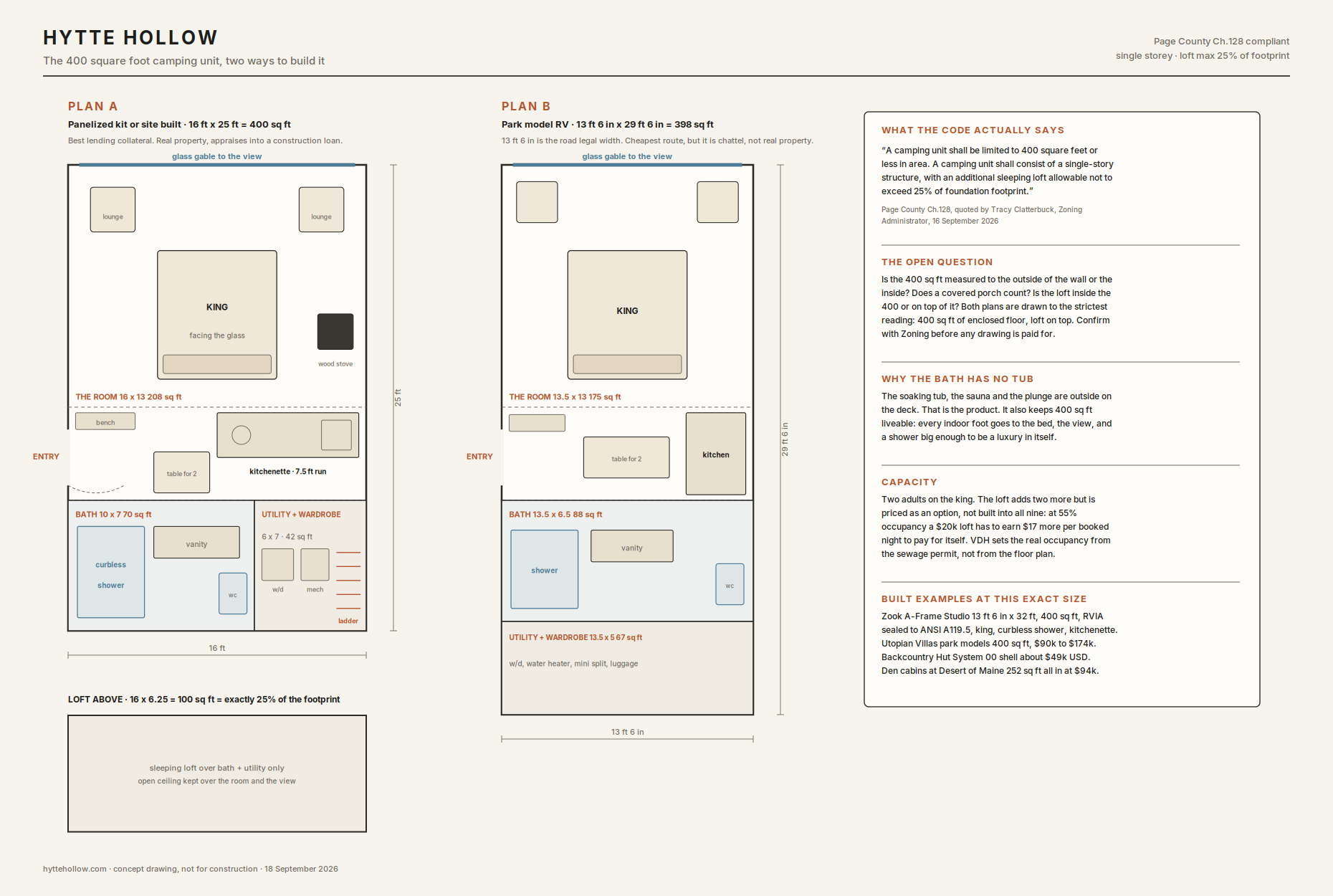
Tracy Clatterbuck, the Zoning Administrator, answered on 16 September and quoted the definition to us: a camping unit "shall be limited to 400 square feet or less in area," a single-storey structure, "with an additional sleeping loft allowable not to exceed 25% of foundation footprint." So the cabin is 400 square feet. Not under review any more, and not negotiable.
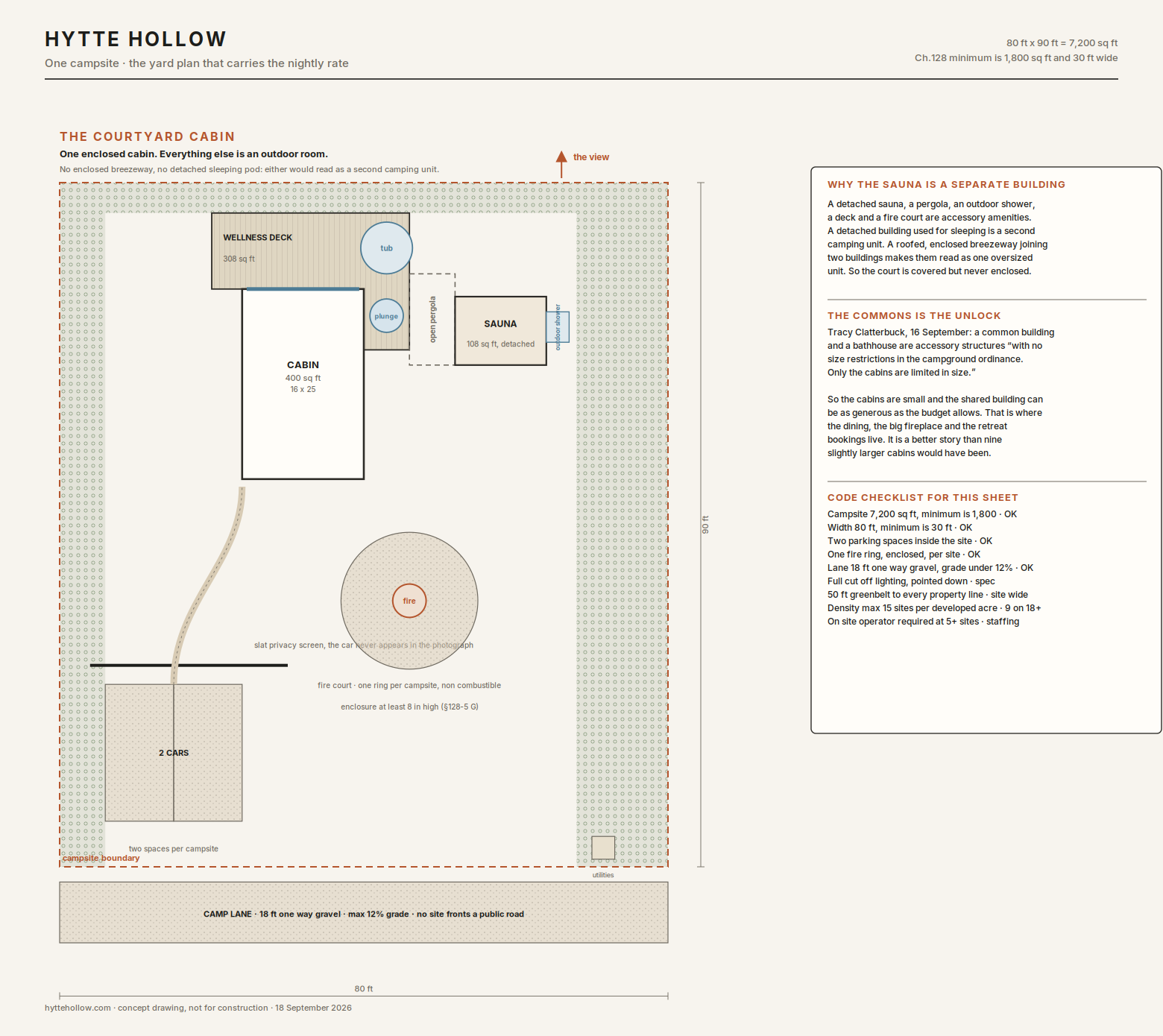
The part we did not expect is better than the part we lost. A common building and a bathhouse, she wrote, "would count as accessory structures for the campground with no size restrictions in the campground ordinance. Only the cabins are limited in size." The greenbelt setback is 50 feet from every property line, confirmed. So the sleeping rooms are small and the shared building can be as large as the budget allows. The hall gets the long table, the big fire and the retreat bookings. The cabin gets the bed, the glass and the deck.
We have drawn it both ways: a 16 by 25 foot panelized cabin, and a 13 foot 6 inch by 29 foot 6 inch park model, which is the widest a finished unit can be and still travel a road. The floor plan is here and the yard plan is here. One question is still open and we have put it to Zoning: whether the 400 feet is measured inside or outside the wall, and whether the loft sits inside that number or on top of it. Both plans are drawn the strict way, so the answer can only give space back.
County
The 400 square foot question.
We read the adopted campground chapter line by line. A camping unit "shall be limited to 400 square feet or less in area," single storey, with a sleeping loft of up to a quarter of the footprint. Cabins are camping units. Our drawing was about 800 square feet with two bedrooms, so as drawn it is not one. We have asked the Zoning Administrators for a call, with this as question one: how the loft is measured, and whether a larger cabin has any other route in the county.
Until they answer, the size, the bed count and the group capacity on this site say under review, and the rate card stays as drawn with a note. What does not change: the sauna, the tub and the plunge on every deck, the hall, the hollow. We re-ran the numbers for nine smaller cabins. At $450 a night and 60 percent occupancy the village still covers its debt 1.31 times, because a smaller cabin costs less to build and the deck is the product. At $425 and 55 percent it does not. That is the honest range, and it is on the ledger page as soon as it moves.
Demand
The park closes its rooms for four months.
Every bed the National Park Service runs inside Shenandoah is seasonal. Skyland, 179 rooms, opens 30 March and closes 8 November. Big Meadows Lodge, 97 rooms, runs 4 May to 29 November. Lewis Mountain's nine cabins, 10 April to 8 November. From late November to early April there is no room to rent inside the park at all.
Meanwhile the park took 1.7 million visits in 2024, its highest count in decades, and visitors spent $132 million in the towns around it. Luray Caverns takes about half a million people a year and stays 54°F all winter. The demand does not stop in November. The beds do. That is the whole argument for a cabin that is at its best in January, and it is why the winter page exists.
Money
What Luray actually charges.
We pulled every market data source we could reach. The average Luray short-term rental books at about $287 a night and half its nights. The average two-bedroom, the most common listing, does $216 a night and about $34,500 a year. The best-performing tenth of the whole market earns roughly $87,000 a year. Hot tubs are in 62% of listings. The closest thing to our cabin, a two-bedroom with a hot tub, sauna and cold plunge, starts at $405.
Our rate card says $595. We are not pretending that is normal here. It is a top-of-market position, and it has to be earned by the product, the winter, and the groups. Two things make us think it is earnable: peer cabin markets with smaller drive-sheds, Hocking Hills in Ohio, Blue Ridge in Georgia, the Catskills, all average $340 to $420 a night on the same occupancy Luray gets. And Luray's largest homes, the nine listings with six or more bedrooms, book at $637 a night. Group demand is real and has nowhere designed for it.
Brand
We renamed it. Here is why.
For two days this was Hawksbill Hollow, after the mountain. Then we found Hawksbill Retreat: seven cabins and a lodge outside Luray, operating since 2014, on the same creek. A good business, and not one we want to be confused with. Renaming costs nothing this week and a great deal in a year.
Hytte, HIT-teh, is the Norwegian word for cabin: the small wooden house a family leaves for on Friday afternoon. Norway has around 450,000 of them for five and a half million people. Henrik's father has rented his out for years. Hollow is what this part of Virginia calls the fold between two ridges where the creek runs and the road ends. Hytte Hollow is the two words put together, and hyttehollow.com had nobody in it.
Demand
What people actually type.
Before writing a page, we looked at what people search for. "Shenandoah cabins" is searched roughly ten times as often as "Luray cabins" and seventeen times as often as "cabins near DC". Almost nobody types "cabins with sauna Virginia"; the phrase does not even autocomplete. People type place first, then "with hot tub".
So the sauna is our difference, not our traffic. The pages lead with the place, Shenandoah, Luray, two hours from Washington, and earn the premium with what is on the deck. It also told us which weeks are quiet: searches for cabins here fall by about a third in January and February. We built the place for exactly those weeks.
County
The county answered in two hours.
We sent Page County's planning and zoning office six questions before putting any land under option. The Planning Director replied the same morning and copied both Zoning Administrators. The path is what we thought: nine cabins on one parcel is a campground special use permit under Chapter 128, heard by the Planning Commission and then the Board of Supervisors. Not a subdivision; that would need a rezoning first. The county holds a formal pre-application meeting once a month with VDOT and the Health Department in the room, and it costs nothing.
Later the same day, after we asked whether the short-term rental standards in the 21 September draft would become our conditions, the Planning Director corrected us: they do not apply to a campground. A campground permit is reviewed whole, under Chapter 128, and he recommended a call with the Zoning Administrators before we spend anything on design. We are asking for that call. We will design to the stricter of the two sets of rules regardless.
He also pointed us to a public hearing on 21 September about short-term rental rules. We read the draft. It does not change our path, but it tells us what the county will expect: a 20-foot access road, a fire ring per cabin, downward-only lighting, a manager within 30 miles, and occupancy set by the health department from the sewage permit. We would rather design to those now than argue later.
The idea
Why a village, and why this valley.
One cabin with a sauna is a nice rental. Nine of them around a hall with one long table is a place a team of thirty can take over, a family reunion can fill, and a couple can disappear into. The village is the product; the sauna on every deck is what makes it ours.
Page County is two hours from Washington, sits under the highest peak in Shenandoah National Park, and calls itself the cabin capital of Virginia. The data agrees: lodging is 39% of the county's visitor economy, the highest share in the valley. It has hundreds of cabins with hot tubs and almost nothing above them. That is the gap, and it is the reason the first thing we did was ask the county how to build here, not whether anyone would come.
The founding list
Read the next entry before it is public.
The list gets each entry, the drawings and the county paperwork first. One email when something happens. Nothing else.
No payment, no obligation. Nothing is for sale on this page.